Sunday, December 16, 2007

Cat Upper Respiratory Give To Dogs

Walter Pall - Tree meeting

WALTER PALL - bonsai video

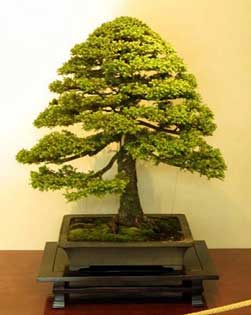
a spruce tree on the occasion of the meeting late summer meeting with Walter Pall Attenham 2007th


Walter Pall is a native Tyrolean and for many years an honorary member of BONSAI CLUB TIROL and is now known worldwide as exceptional bonsai designer, who has not only design skills he has acquired in many years, but which also has the ability, his philosophy and his views very effective and "popular" (especially in the Bavarian and Tyrolean room ) brings to the man or the woman. Its refreshing way to approach the topic of Bonsai is impressively demonstrated in this video.

More info about Walter Pall: ==> German website or English website (new)

Saturday, December 15, 2007

How To Design Body Temperature Sensor Circuit

BONSAI VIDEO

VIDEO to Remember "BONSAI" from:

Video 1

Video 2

Video 3

Monday, December 10, 2007

My Dog Has A Pinched Nerve What Can I Do


Accent be used in bonsai exhibitions to the exhibited bonsai with its significance of the to support presentation.
Accent, in addition to bonsai lovers for some a coveted collector's item.
The compilation and maintenance of such plants is an art.
Wolfgang Putz is now not only in Europe but also internationally known for his extraordinary Beistellpflanzensammlung. Wolfgang Putz not only knows every one of his plants in his botanical name, he also knows the individual care needs of all its plants perfectly.
On his website , which is incidentally one of the most interesting, most informative and diverse websites in terms of Bonsai in Europe, you can also find out more about Accent.
more interesting information on Accent in the form of grass can be found on the bonsai Homepage Fritz Baier

Thursday, October 18, 2007

Does Green Tea Improve Cervical Mucus?

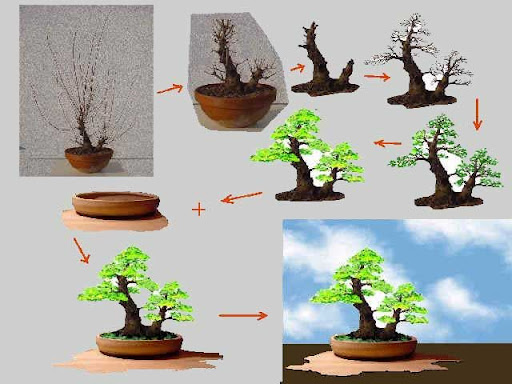
VIRTUAL

VIRTUAL ....
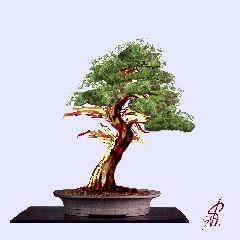
... are digital images that can be changed by the computer purely technical DV editing. For this purpose, a photo editing program with the minimum necessary functions. For more complex jobs, of course, a correspondingly more expensive program is necessary. In
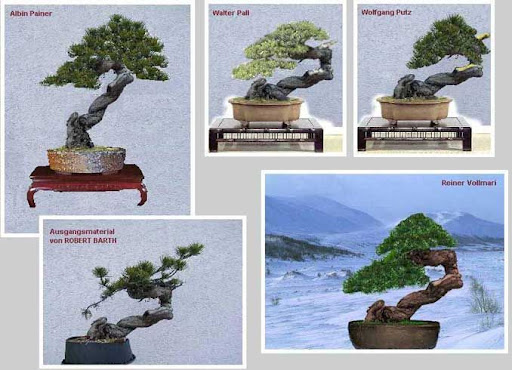
BONSAI used this technique to existing material (eg Yamadori, or nursery stock) photographically portray as it can possibly be made in future, or should. Already pre-designed material can be reworked, and give the owner new design ideas. Not always in kind can also occur as the implementation of the "artist" this represents, as can be determined only by the images are not exactly the starting points of the branches.
It is raw material for the owners of help for his design work. It is also for the virtual artist and a very instructive discussion of the design principles in the bonsai art and helps him to better "see". In
relevant Internet forums used this technique as a mutual aid like (see links page)
............................ ..................................

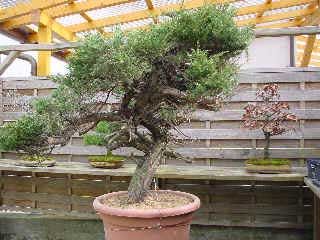
juniper Albin Paine:


.................................................. ............

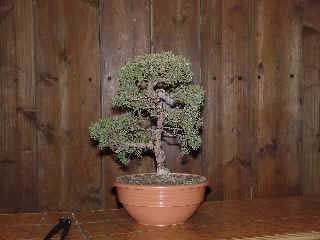
juniper Andrea Pescoller:


................................ ..............................
Japan Sycamore Albin Painer
"How is a Virtual"

Actually, this is more of a drawing, as the branches and leaves but also digital, but here were made using a drawing tablet. "Real" is really only the stem and the bowl.
............................................ ..................
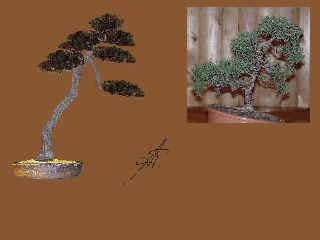
same Basic material needs do not always lead to the same conclusion:


What Does Your Cm Taste Like When Pregnant

Bonsai Accent Table by Sepp Hofer

BONSAI TABLE
of
Seppenhofer
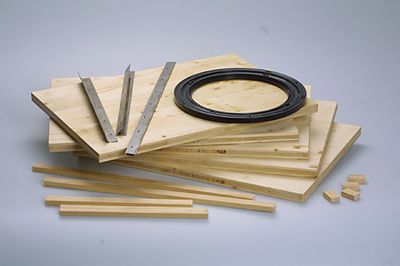
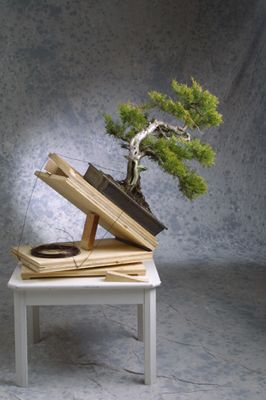
I was always amazed that at demonstrations and in bonsai magazines tilting always improvised with wedges and beer crates had to be overcome. I thought about it and then I built the following construction which can be easily produced by any hobbyists themselves.
mounted on a turntable I 3 wood boards with hinges so that it can be tilted in 3 different directions. The 4th Tilt direction is achieved by turning the adjuster.
ball bearing swivel elements you get in the hardware department of a hardware store.
5 table glued panels can be tailored to the hardware store in the desired size and does the same with a piece of lath. From this you cut down 4 small pieces and attached them as feet with a little glue and a nail or small recessed screws on the bottom of the first panel. On the top board is mounted in the same manner 4 strips, as shown in the photo, that the bonsai pot by tilting can slip off. leaves at the corners is a gap to allow water or dirt can be removed easily.
grind Now you all the edges with fine sandpaper or the like from time lackert all. After drying, again grinds all surfaces and edges smooth and painted a second time Now it can go to the assembly!
We fixed the time being only 2 screws with the rotary member. It is important to assemble all this centered, otherwise the plate wobbles when turning. Then you drill through one of the holes of the rotary member for the board against a hole, replaced the swivel down again in order to extend the drilled hole with a large drill bit, so that the screws for can push through the counter board, together with the screw head slightly. We again attached the rotary member with the screw holes in the previous spins and then into the remaining screws.
Now you screw the board to counter and sticks to the first screw through the expanded hole, plugged into the next bolt and screw in so the can turn all the screws through the same hole. So that the turntable is ready.
now on the narrow side of the 3rd Wood panel, the hinge mounted. I use this a so-called piano hinge, which can be cut in each of suitable length and that 2-3 mm shorter than the board. (Of course, there may be another hinge.) It is appropriate that to sink as shown in the photo, with a plane or a router, which indeed have many Bonsaianer. Who do technically is not in a position to have to put on the opposite side to compensate a bit thin strip of wood, plastic or cardboard. If you do the milling prior to painting, and this place is mitlackiert. Now we screw the hinge of the 3rd Board on the turntable. Now comes the 2nd Hinge on the other narrow side between the third and fourth board and then the third between the long side of the fourth and fifth board.
Finally, we turn now to three Sides a wooden or metal button on the third, fourth or fifth board (see photo) so you can lift the Kippteller depending on demand, in order to define a wedge.
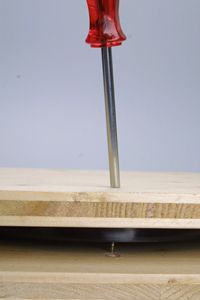
This is the turning and Sepp HOFER Kippteller done. Those seeking extreme but Kippgestaltungen (over 45 degrees) may, in the second board, as shown in the detail photo, screw a few screws, where you can mount the dish with bonsai wire.


by the company Wolfcraft there is a practical DIY dolly. The role can be removed with a screw. If you get a connection for the bonsai table does make, or have it, you have a stable folding, quickly adjustable in height stand.

Seppenhofer
Bonsai Club Tirol

Yahoo Messenger Web Camera Not Supported

BONSAI ON WIKIPEDIA


Wednesday, September 26, 2007

How Much Will Cost For Cataract Operation In Hyd

BONSAI GLOSSARY OF

Akadama
... is a brown Lehmgranulat that is imported from Japan. These granules are degraded by, and dried in the sun. Akadam is ideal for "all" types of bonsai
Aioi
... Double or twin master
Ashi
... are the feet of a bonsai pot
Akamatsu
... Japanese red pine
Arakawa
... describes a rough bark or crusts
Arboretum
... An exhibition area for bonsai and all the trimmings.
road
... is a woody (hardened) engine
eye
... is a bud that forms the basis for a branch.
Bankan
... is an extremely geschungener strain.
Bonkei
... is a miniature landscape.
Bonsai
... means tree in the shell or on a tray
Bunjin-gi
... is a form of design, the stem rather thin, but with distinctive curves and only in the upper part with a sparse crown. Hardly a bonsai shape is minimalist and yet so meaningful.
Chokkan
... Steng upright design form.
Chumono
... Bonsai is the size of 40cm to about 100cm.
DAI_SHAKKAN
... is a Gestalungsstiel with an extremely inclined stem
Eda
... Ast
Ezomatsu
... Ajanfichte
Fukinagashi
... is a wind-whipped shape.
Futokoro-eda
... is a branch of a bonsai
gobo
ne ... is a taproot.
Go-kan
... Bonsai is a five-speed trunk.
Goyomatsu
... Japanese white pine
Ha Zashi
... is called the leaf section.
Hige
ne ... are the fine and fine roots.
Han kengai
... is a Semi-cascade. The difference from the cascade is that the crown goes no deeper than to the peel front.
Hinoki
... Cypress
Honbachi
... Bonsai
Hokidachi
... which offers classical form is called broom.
Ichii
... Yew
Ichino-eda
... is the first important road
Ikadabuki
... is called a raft shape.
Ishitsuki
... the rocks form. One or more bonsai are planted on a rock.
Jin
... is a dead branch and bark. known as Jin is also a dead bark. This design method can be found mainly in coniferous woods.
Ju was
... is the growth of a Bonsai
Jushin
... is the tip of a bonsai.
Kubudachi
... is a Gestalungsform. One or more stems grow from a common root striking.
Karin
... Quince
Karikomi
... is the trimming of the leaves and branches.
Katade-moche
... Bonsai is the size between 20 and 40cm.
Kasa-zukuri
... Umbrella form
Kanju
... is deciduous trees
kengai
... is a cascade. The crown extends below the cup.
Kaede
... Trident Maple
Kaido
... Ornamental
Keto
... A soil mix that is specifically designed for rock plantings or planting tray.
Kokejun
... is a strain that is clearly taper towards the tip - an important feature for a bonsai.
Korabuki
... This form has a Wurzelanstatz like a "turtle shell".
Kusuri-mono
... is a glazed bonsai pot
Kuromatsu
... Japanese black pine
Meiboku
... Bonsai is a great age.
Mame
... Bonsai is the smallest size to about 10cm height - pure tree height - Shelled.
Mae eda
... anterior branch of a bonsai.
Miki
... Master
Misho
... is raised from seed.
Misho momo
... one reared from seeds Bonsai
Mizu-gire
... Water shortage.
Me-kiri
... refers to the pinching (pluck selected group) of the new shoots.
Me-tsumi
... is pluck the leaves - even needles.
mochi komi
... is one of the highest attainable levels of cultivation. This power is only achieved after years (decades of) culture.
Momiji
... is a Japanese Maple.
Moyogi
... loose, free and erect Gestalungsform.
Neagari
... is the Gestalungsform with exposed roots. They act as if they had been washed out (stilt-form).
Nebari
... the roots of a bonsai. The Nebari is the part of above ground and visible roots to Stammanstatz. A strong and regular Nebari is the most amazing thing is There
Nejikan
... is a Gestalungsform with twisted stem.
Ni-no-eda
... is the second branch of a bonsai
Ne Zashi
... Root pruning
Nishiki
... is the Kordinde in a maple or pine
Oyaki
... is the mother plant is from the abgemoost.
Sabamiki
... is a well Hölter or "zerrisserner" tribe. This technique is often called "age" to use a bonsai - again mainly conifers!
Sabi
... is an expression of the maturity and beauty of a Bonsai.
saikei
... is a landscape design that is more realistically simulated.
Sakura
... Cherry
Sankan
... Triple root
San-no-eda
... Third branch of a bonsai
Sashi-ho
... Cutting
Sashi-eda
... main branch of a bonsai - also called the main branch.
Satsuki
... Azalea
Shari
... is a peeled and dead area of the tribe.
Shohaku
... Conifers called on conifers.
Shin
... is a slim and upright form of design
Soro
... Beech
Shohin
... Bonsai is the size to about 20 cm - pure tree height - Shelled.
Sokan
... Double strain
Sugi
... Japanese cedar
Suiban
... is used for the presentation of Suiseki - a bottle of dish mean filled with sand or fine gravel.
Suiskeki
... is a stone with a special steel frame. It may be different motifs identified in it or even a landscape display.
Tachiagari
... is the lower part of the tribe - from the roots emerge from the first branch. This area is also very important!
Tokoname
... is the pottery town in Japan.
Toriki
... is a bonsai, which has been produced by abmoosen.
Tsugi
ki ... is the process of finishing or grafting.
Tokonoma
... is an exhibition room in the house. The Tokonoma used to present the bonsai inside the home.
Tosho
... Hedgehog juniper
Uke-eda
... Gegenast
Ume
... Apricot
Ura-eda
... Rückseitenast a bonsai.
Yamadori
... is a tree that is dug out of nature. A Yamadori has been edited by wind and weather already and is best suited for the shape of a bonsai. Yose-ue

... is called a forest form. Again, as always - has an odd number of tribes interesting.

How To Thank Anyone By Email

Pinzi larch and beech

Pinching of larch:

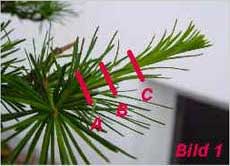
Figure 1

shows the possibilities pinching to varying degrees:

pinching up to point A) when only a fine-branch be built needs.

pinching to point B) or C) when provided here a small road is

No Pinching if growth is to be encouraged - but here caused large internodes

can of course also be compensated in this way the different levels of vigor in larch (Pinching strong vigorous parts stronger / Pinching weak vigorous plant parts weaker )

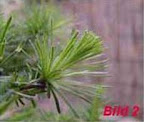
Figure 2

less developed long shoot or only new work, long drive.

Weak long shoots that are not pinziert have similar effect as a pinching until Punk A) or B)


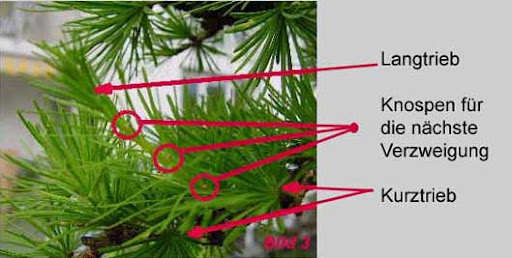
Figure 3


Here we see a good 2 short shoots and the long shoot very well the new buds for the next branch (usually only for next year)
Pinching of Book:

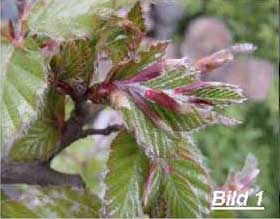
Figure 1

This is just a good time to pinching


Figure 2
If the bud is still so closed, but you can if you know the technology, even pinching already, but it is something more difficult!


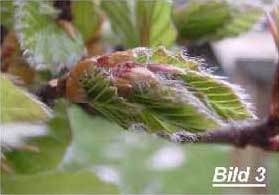
Figure 3

This stage of the bud is the optimal pinching!


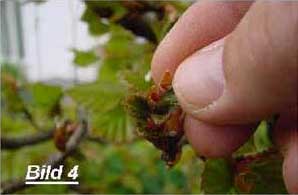
Figure 4

Take the bud between the fingers - but only the leaves at the top - and turn them back so that one or two leaves remain. If you do it right (almost always goes in one direction only), then cancel the desired parts slightly and the rest remains intact.

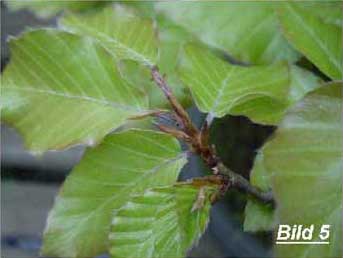
Figure 5

This date is absolutely too late for pinching.

But you can cut very well at this time also, so that one has but not the positive effect that the view develop shorter internodes.